Children of Transaction: The Origins and Birth of Transaction Art
In conventional accounts of an artist’s development, the path is often explained through continuity: a supportive environment, family traditions, and a steady progression through academic education and international residencies. The origins of Transaction Art, however, are fundamentally different. This is not a story of inheriting an artistic environment, but of confronting systems of power, organised crime, threats, and harsh economic dependencies.
1. Threats to Life and the First Invisibility
The realities of life in the post-Soviet world brought my family into direct confrontation with criminal pressure: organised crime, blackmail, persecution, and threats of physical violence, including the threat of my elimination as a means of coercion.
As a security measure, I was literally hidden away in London — without money or established connections.
Forced isolation and the need to remain hidden became my first fundamental experience: invisibility initially emerged not as a conceptual gesture, but as a condition of survival and safety.
Once in London, I enrolled at Central Saint Martins, where the foundations were laid for my later examination of institutional and economic systems.
2. Encountering the Art Market and the Birth of the Manifesto
The turning point came during an encounter with a Mayfair gallerist, who would later become a symbolic figure and muse of Transaction Art.
His words set a decisive direction for what would become my artistic statement:
“You are nobody (a hidden face) in London. Thousands of people just like you arrive here every day to become nobody. And you will remain nobody here until you have a certain amount of money in your bank account (Transaction) and become best friends with the British aristocracy (Transaction).”
These words became the foundation of the first Transaction Art manifesto:
“We are the children of war. War is money. Money has no face. Everything is as simple as a transaction. We are the children of Transaction. We are the children with hidden faces.”
3. The Amsterdam Performance: Transforming Circumstances into an Artistic Language
In 2012, these ideas were presented publicly for the first time during a performance in an old Catholic church in Amsterdam.
The occasion arose from my participation in an art fair and an unexpected incident. The organisers gave my stand, originally located in a busy, high-traffic area, to other people, moving me and two other artists to the farthest corner, where visitors simply did not reach us.
The performance itself became a radical response to this marginalisation:
- I appeared half-naked, wearing a blue balaclava that completely concealed my face and identity.
- Around my neck was a stiff, starched black collar in the style of the sixteenth century — a historical marker of high social status and hierarchy.
- I responded to every question and attempt at conversation from visitors with complete silence, keeping my hand tightly clenched into a fist. Whenever someone approached, I slowly opened my palm, revealing a single symbol written in red: “No”.
4. Signs of Fate and the Emergence of a Larger Structure
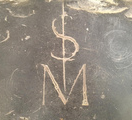
By coincidence — or perhaps as a sign that would determine the direction of what followed — a stone slab lay directly beneath my feet, precisely in the area where my exhibition stand had been allocated.
The only inscription on the slab, $M, was identical to the signatures on my paintings.
After the art fair ended, I began asking the church staff what the slab meant. It turned out that the church had been destroyed during the Second World War and that, during its reconstruction, the floor had been laid with stones brought from different parts of Europe. This particular slab might once have belonged to a noble family.
Following the performance, I attracted enormous interest from the professional art community. Numerous offers of collaboration began arriving from representatives of the art market.
Yet standing in the centre of the church, with dozens of cameras trained on me, I realised with absolute clarity that, within this system, the artist remains merely a cog in the machinery and an object of someone else’s transaction. I was not prepared to participate in it on terms imposed upon me.
Soon afterwards, the tightening of immigration policy in the run-up to the Olympics made it impossible for me to remain in the United Kingdom. Subsequent visa complications resulted in a ten-year ban on entering the country.
Once again, personal circumstances had made me part of a global transaction, turning exile itself into a continuation of my artistic practice.